
Choosing your engagement ring diamond is a really big decision, both in terms of emotions and also the financial cost – and that’s the same for any type of stone for an engagement ring, not necessarily just diamonds.
You want to choose a stone that is going to last, without needing to be replaced years down the line.
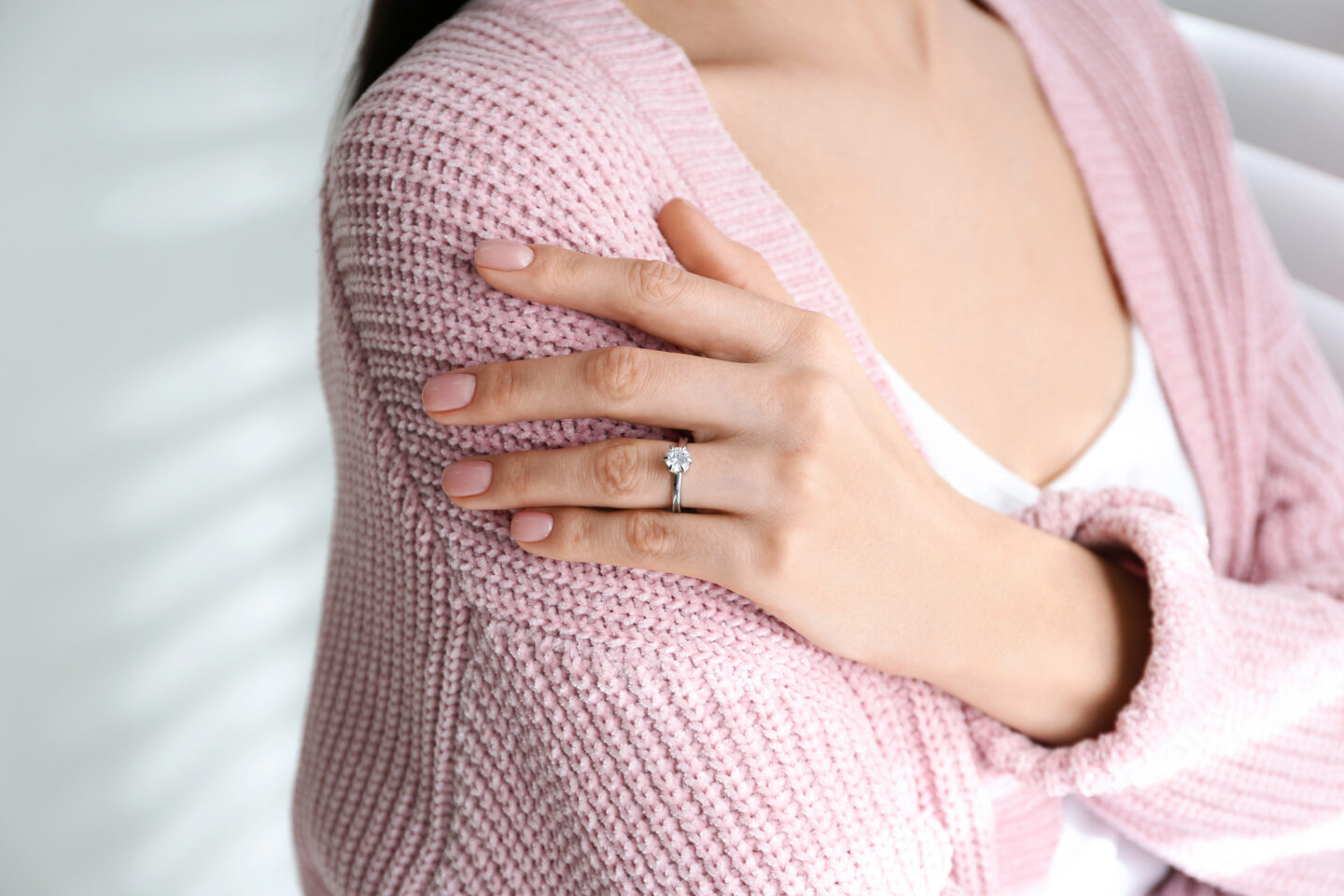
The Four Cs Of Diamond Quality
If you’re going for a diamond, there are four C’s to consider; Cut, Color, Clarity and Carat.
These allow you to compare diamonds in a clear and consistent way.
They are the industry standard for diamond grading, and the often appear on a diamond certification from organizations like the Gemological Institute of America (GIA).
The CUT matters most for the diamond’s sparkle, as the cut quality controls how light returns to your eye.
Even colorless diamonds can look dull, if the cut of the diamond is poor.
The COLOR of a diamond can range from colorless to a light yellow or brown color.
You may prefer a colorless or a near-colorless diamond, depending on your ring setting and your budget.
Settings in yellow gold tend to hide slight color, than a white metal does.
The CLARITY refers to any inclusions and surface blemishes inside, or on the diamond.
Most inclusions are microscopic, and winter the beauty at a normal viewing distance. Choose a clarity grade that balances visible purity with cost.
Lastly, the CARAT is the diamond’s weight. This impacts the size of a diamond, and the price.
Two diamonds of the same carat can look completely different, depending on the cut and proportions.
Choosing The Right Diamond Shape For Your Style
Your diamond shape sets the tone for your whole engagement ring.
Choosing a round diamond is a classic, and maximizes sparkle, while a princess cut offers a more modern, square look with strong edges.
Think about how the setting will pair with the shape of the diamond.
Solitaire settings highlight the stone alone, and works well with round or princess cuts.
Halo settings add extra sparkle, and makes the center diamond look larger.
Bezel settings give you a low-profile secure edge that suits more active lifestyles, as they tend to catch on things less.
Metal choices also change the whole look of the ring. Platinum and white gold keep the focus on the brightness of the diamond.
Yellow gold gives you warmth and some vintage charm, while rose gold gives a softer, romantic tone and pairs well with warmer skin tones.
Consider daily wear and the practicality. Prong settings life the diamond, for more “fire”, but will occasionally need tightening to keep your diamond safe.
Bezel and low-profile style protect the edges and reduce potential snagging.
Finding The Right Balance Between Carat Weight And Budget
Stat by setting a clear budget before you start looking at engagement rings.
When you know your price range, it’ll help narrow down the choices for your carat weight, the cut and setting without wasting time.
The carat weight affects the price more than the other factors.
You can often get a bigger looking diamond for less, by choosing a slightly lower carat just under a popular size (for example, a 0.9 carat instead of 1.0 carat).
Think about how the diamond sits in the setting. Well cut stones in a clever setting can look larger and brighter than a heavier, poor-cut diamond.
If you chose a halo setting, or a thin band, it can make the diamond look bigger than it is, so you can prioritze the cut/clarity, while keeping the weight (and the cost) lower.
Natural Diamonds & Lab Grown Options
There are two types of diamond. Natural diamonds are mined, after being formed over millions of years, or there are lab-grown diamonds.
Both are real diamonds, so they look and wear similarly, but they have very different price tags.
Lab-grown diamonds generally cost between 40 to 70% less than a natural diamond would.
Allowing you to get a larger or higher-graded lab grown diamond engagement ring for the same budget. Although, natural diamond typically hold their value better, over time.
For both types of diamond, the 4Cs still apply, to help you compare stones, regardless of their origin.
Always ask the seller for paperwork when buying a diamond jewelry piece, so you know what you’re getting.
If sustainability matters to you, lab-grown diamonds have a smaller immediate environmental footprint.